We provide professional downspout drainage services in Great Falls, MT for overflowing gutters, improper runoff, foundation pooling, and soil erosion caused by clogged or misdirected downspouts. Installations and repairs regrade drainage lines, extend downspout outlets, and clear blockages to move water safely away from the structure and prevent basement leaks, foundation shifting, and landscape damage. Request a quote today.
Why Does Downspout Drainage Overflow During Heavy Rain?
Downspout drainage overflows during heavy rain when water volume exceeds the system’s capacity or when blockages slow discharge. Leaves, shingle grit, and compacted debris inside elbows or underground lines are the most common causes. This forces water to back up and spill at the downspout outlet instead of flowing away.
How do Missouri River breaks storms and high plains terrain affect downspout drainage in Great Falls?
Strong wind-driven storms and snowmelt can create sudden runoff across open residential areas. In neighborhoods near downtown Great Falls and surrounding Cascade County communities, elevation changes near river breaks often direct water toward lower foundations. Downspout drainage helps control that flow before pooling occurs.
How Do You Know If Downspout Drainage Is Clogged Underground?
You can tell underground downspout drainage is clogged when water backs up at the downspout base or pools around the foundation after rainfall. Slow drainage or gurgling sounds inside the pipe are also common signs. In many cases, the blockage forms at bends or where the pipe connects to the outlet.
What Is the Difference Between Downspout Extensions and Buried Drainage Pipes?
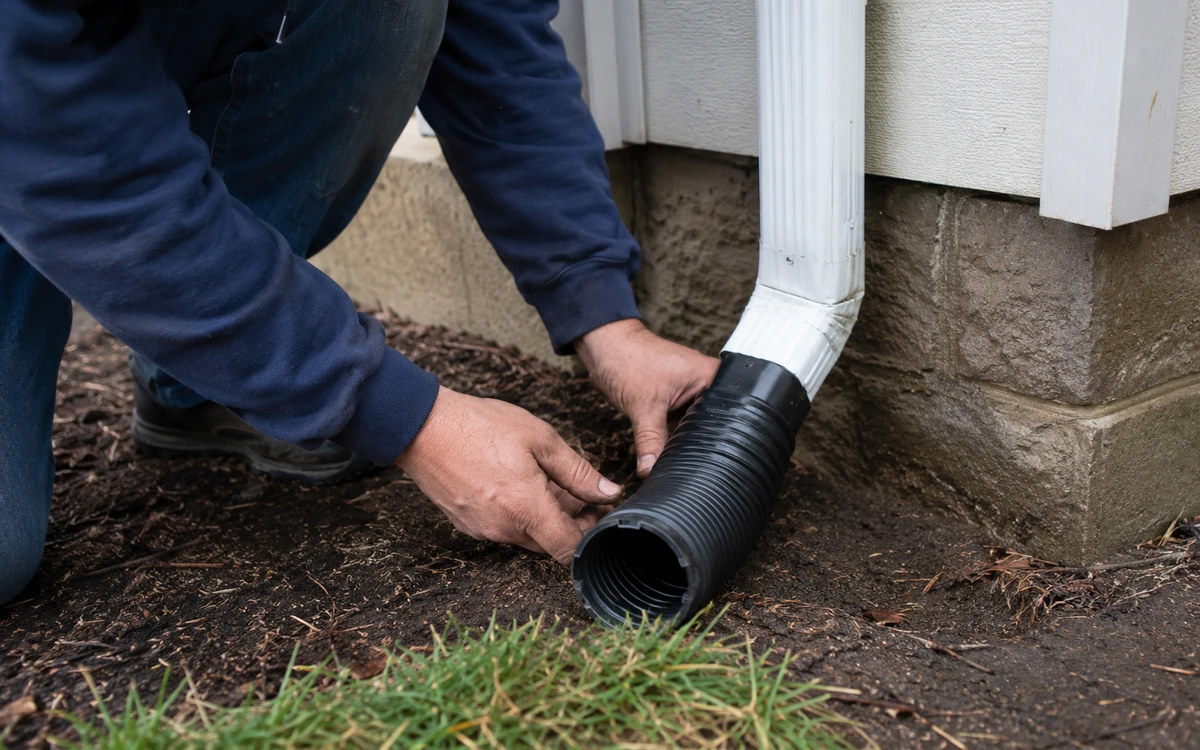
Downspout extensions carry water above ground, while buried drainage pipes move runoff underground to a discharge point. Extensions are easier to install and inspect, but buried systems handle runoff more cleanly and reduce surface erosion. The main difference is exposure versus permanent underground routing.
Can Poor Downspout Drainage Cause Basement Leaks?
Poor downspout drainage can directly cause basement leaks by allowing water to saturate the soil around the foundation. That pressure pushes moisture through cracks and weak points in basement walls. Over time, repeated saturation increases the likelihood of persistent interior dampness.
Why Does Downspout Drainage Freeze in Winter?
Downspout drainage freezes in winter when trapped water inside the pipe is exposed to sustained freezing temperatures. Poor slope or partial clogs allow water to sit instead of fully draining, which accelerates ice formation. Once frozen, the system can become completely blocked until thawed.
How Often Should Downspout Drainage Be Cleaned or Maintained?
Downspout drainage should be cleaned at least twice a year to prevent debris buildup and flow restriction. Seasonal maintenance is especially important after fall leaf drop and spring storms. Regular inspection helps catch small blockages before they turn into full drainage failures.
How Much Does Downspout Drainage Cost in Great Falls, MT?
Downspout drainage costs in Great Falls, MT typically range between $567 and $2,793, with estimated pricing depending on number of downspouts tied into the system, total linear feet of buried drain line, and whether installation requires trenching to daylight, dry wells, or storm sewer connections. Pricing can also vary based on soil conditions, excavation difficulty, property grading requirements, root or utility interference, and the extent of surface restoration required after installation.